 |
Leadership Development Workshops |
     
|
Leadership Development Videos from Roger Reece
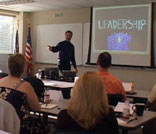
Roger Reece teaches leadership development in the clips below, taken from recent coaching workshops and seminars with various clients. Roger draws on his 25 years of corporate management experience in his leadership training, but makes a clear distinction between management and leadership in concept, and stresses the importance and applicability of leadership development at every stage of your career in practice.
We hope you will also visit our Youtube channel for dozens more clips on many of the training topics Roger Reece Seminars provides.

Ownership, Influence and Complaining
Often the most difficult obstacle in dealing with communication problems is the absence of a sense of ownership. People don't take take charge of a problem around them because a voice in the back of their heads keeps repeating, "It's not my job." The problem belongs to another department (the voice says), or it is the fault of another person who refuses to meet us halfway. But the net result of all this blaming is powerlessless and victimhood; and it expresses itself to others as an attitude of passive complaining. It may very well be true that the ideal solution to a problem you have is definitively out of your hands. But there is nearly always something you can do to affect the situation in some way. And every effort you make in this direction moves you farther down the path of ownership and influence, and away from victimhood and complaining.
Influence, Fear and Retribution
When you have a fear of retribution, what do you do? Say nothing? Do nothing? Avoid it? Withdraw? If you choose to confront a problem head-on, you may indeed face a risk of negative reactions or consequences. For every single person you interact with, there is a 'line' you should not cross. But that line is shaped differently with each and every one of us. How do you know how direct you can be, what demeanor a person will respond to, or what type of questions will provoke them? It's kind of like a minefield.
One approach to this minefield is to stay as far as far back from the line as you possibly can, so you don't set off an explosion by accident. A far more influential approach, though - especially with someone you interact with frequently, or who (like your boss) has decision-making powers above you - is to map out the line over time by carefully approaching it in different areas. You will set off a few small explosions in the process, to be sure; but the level of influence and 'push'-potential you gain make it well worth the effort.
Selling Your Ideas
Anything worth doing has costs associated with it. These costs can come in the form of money, time, resources, even the opportunity costs of choosing one idea over another. So presenting an idea to a decision-maker becomes very much a sales situation. For anyone to see the value of an idea, you've got to build up the perceived benefits of that idea in the person's mind. This is where most people stumble in the process. The job of the person presenting - selling - their idea is to focus on the benefits to the problem-solver - not on the benefits to themselves. They should expect to encounter objections, and prepare themselves for the many different ways their proposal may be challenged. The genius of an idea means nothing if the person in control of implementing it doesn't see that idea's value.
Influence through Assertiveness
There is almost always a risk involved in expressing your opinion. If what you have to say contradicts what someone else has said or what they believe, and you don't make yourself understood or are misconstrued, you could face intimidation, reprisal, or just risk looking like a complainer. This is why so many people choose not to speak up at times when they know they have something constructive to say: if you never say anything, you don't risk getting the wrong response. Keeping quiet is the safe road. But the safe road is most definitely NOT the path to leadership. Leadership is choosing specifically to not take the safe road - to assert yourself and share your information and insight for the benefit of the entire team (and get valuable practice in improving your communication skills at the same time).
The Non-Assertive Trap
The habit of non-assertiveness is a difficult trap to break free from. It is built on the rationalizations we tell ourselves to hide the fears we feel. We may feel vulnerable about expressing ourselves in certain situations: in meetings, in the presence of senior managers, when meeting new people or with strong, controlling or difficult personalities. We don't want to risk a reprisal or look stupid. But when we let things go, things tend to fall apart. If we have something to share, and we keep it to ourselves, what value are we adding to the situation? Breaking out of the non-assertive trap requires a conscious decision to make yourself vulnerable by speaking out - when you have information to share, when you have a question, when you see a problem that needs to be solved - in spite of your fears of reprisal or embarrassment.
Leadership & Resource Management
As leaders, we are all resource managers. The effect of great leadership is to inspire the people around you to do more and to work at a higher standard than they would otherwise on their own. There is a level of "discretionary effort" between what is acceptable to remain employed, and the best that a person can do, and that difference is directly the result of active engagement and a feeling of personal investment in one's work - an energy level fueled by the sense of value that comes from rewards not directly tied to a paycheck. In that sense, a leader is really a Resource Manager, and the mission of the leader is to tap into that energy source of inspiration. Effective leadership, then, shows its results very clearly in the increased productivity and greater output of a team, and the feeling of loyalty to the organization and higher degree of self-management displayed by individual team-members to the work at hand.
Employee Success is the Manager's Responsibility
Speaker, trainer & coach Roger Reece speaks to a group of managers in a Leadership Development seminar in 2011, describing how "victim monologues" - his term for the mental model that causes a person to unconsciously cast him- or herself as a victim in various situations - are what lie behind most of the chronic complainers and demotivated employees in the workplace. He explains the manager's responsibility to make their employees successful: to make them accountable for their performance; to learn how to motivate them; and most of all, to learn how to change the flawed mental models that hinder their ability to succeed and be happy, at work and in their personal lives.
Listening is the Basis of Leadership
In difficult situations or confrontations, it is the manager/leader's responsibility to be the stable one, to be the voice of reason. Of course you know your agenda, but be patient - you'll get your chance to say what needs to be said. The first and most important job of a leader in situations of stress or conflict is to make sure that the employee or coworker feels that they have been heard. This does not mean that your opinion won't differ, or that you won't follow through with your agenda. It is not important that the employee feel like you agree with everything they say. What matters is that they feel they have been given a fair opportunity and space to present their point of view. (And sometimes, they just need to vent.) The respect that you convey to the other person, by giving them a chance to speak and be understood - by actively listening and showing that you are willing to consider their input - begets the same weight of respect back to you, that ensures that they will listen and take seriously what you have to say, when your turn comes to speak.
Success & Leadership Competency
Your success rate is the measure of your competency as a leader. When hiring, you have to make decisions based on limited information; and sometimes what you get is not what you expected from the interview cycle. In a way, your contract with an employee is a bit like a marriage contract: you commit to a package that includes the unknown when you take them on as a member of your team; and now, for better or worse, as a manager you own the responsibility for their success. Determination is an essential quality of leadership: we will always have to take ownership of commitments without knowing exactly what we will get, and determination is the resolve to see those commitments through. As managers, our goal should be the ability to take any qualified person and make them successful as an employee, regardless of whatever blind spots, neural hijacks or baggage they carry along with them.
Leadership Influence: Getting Buy-In
The importance of getting your team's buy-in cannot be overstated. It is human nature to ask "why?" As a manager, you should expect and encourage the question, because it is the best gauge you have to determine if the reasons for your instructions are understood by your team. Your goal should not be compliance. What you really want is the 'buy-in' of the members of your team: you want them to understand and respect the reasoning behind your decisions, the overall considerations that drive your directives. Without your team understanding the 'whys' behind your decisions - without getting their buy-in - they will see them as petty and arbitrary, and their respect for you will suffer.
Every interaction you have with one of your employees is either building the respect and trust level, or tearing it down. Every action, every interaction, with any employee is building an image of you in every employee's mind, of your effectiveness as a leader.
Leadership: Managing Behavior
Avoid generalities! When coaching or training employees, or attempting to effect change in anyone, it is important to focus on specific behaviors. A generalized statement like "You've got a bad attitude" is bound to derail the conversation. First of all, you haven't given the other person any useful information on how to change, or any instructions on what to do to meet your expectations. Worse than that, the more vague and non-specific your statement is, the more likely you are to be interpreted as critical of the person's intentions. The fact is, the vast majority of problem behavior is done with good intentions, at least from the person's own perspective. The person at fault usually is either unaware of the problem, or mistaken about the results of their actions. Questioning the other person's intentions - or from their perspective seeming to do so - will only cause them to resist or discount anything else you have to say.
Always focus on specific, actionable, changeable behavior. Never question the other person's intentions - in fact, you should always assume a positive intention behind behavior. That way, what could be a difficult conversation will be framed in terms of helping them to better achieve the results they were already working toward.
|
|
|
|